All case studies
Digital product infrastructure
Secure licensing infrastructure built for production scale
How Brick Software helped Keydros and Kivo Studios protect distributed digital products without turning licensing into a point of failure.
- Author
- Brick Software Engineering
- Published
- Reading time
- 6 min read
ClientKeydros and Kivo Studios
LocationEurope
IndustryDigital products and video game distribution
ServicesDistributed infrastructure, licensing APIs and workflow automation
Licensing had become part of the product
Independent game studios selling outside centralised platforms still need to control who can access their products, which versions a customer may use and how protected assets behave after distribution.
For Keydros, that made licensing more than an administrative feature. A slow check would delay legitimate customers. An unavailable service could block software that had already been purchased. A predictable request could be replayed by an unauthorised installation.
The central engineering question was simple to state: how do you enforce licensing controls without allowing the licensing system itself to become a single point of failure?
- Authenticate customers and installations
- Control access to permitted product versions
- Detect expired or replayed requests
- Support controlled offline operation
- Remain responsive during traffic spikes
Two trust stages, one clear decision
We separated authentication into two stages. The first verifies that the protected product is operating inside its expected script environment. The second sends a signed request to the distributed edge infrastructure, which validates the licence, permitted version and freshness of the request.
HMAC-SHA256 signatures prove that a request has not been changed in transit. Time-bound request data limits how long a valid exchange can be reused. No individual check is treated as sufficient on its own.
Request pathMultiple trust layers
01Protected resource
02Runtime validation
03Signed request
04Cloudflare edge
05Licence and version check
06Authorisation decision
HMAC-SHA256 signedTime-bound requestVersion controlled
A repeatable protection workflow for Kivo Studios
Kivo Studios needed to protect distributable FiveM map assets without creating a complicated publishing process. We built Blitz around the workflow the studio already used.
The publisher uploads a .yty file. Blitz generates a unique seed, a protected asset and its runtime script. The distributed asset stays unusable until the customer identity and permitted product version are validated through the shared Keydros infrastructure.
This gave Kivo a familiar way to publish while retaining control after delivery. Only an authorised installation receives what it needs to reconstruct the asset at runtime.
Proven under production traffic
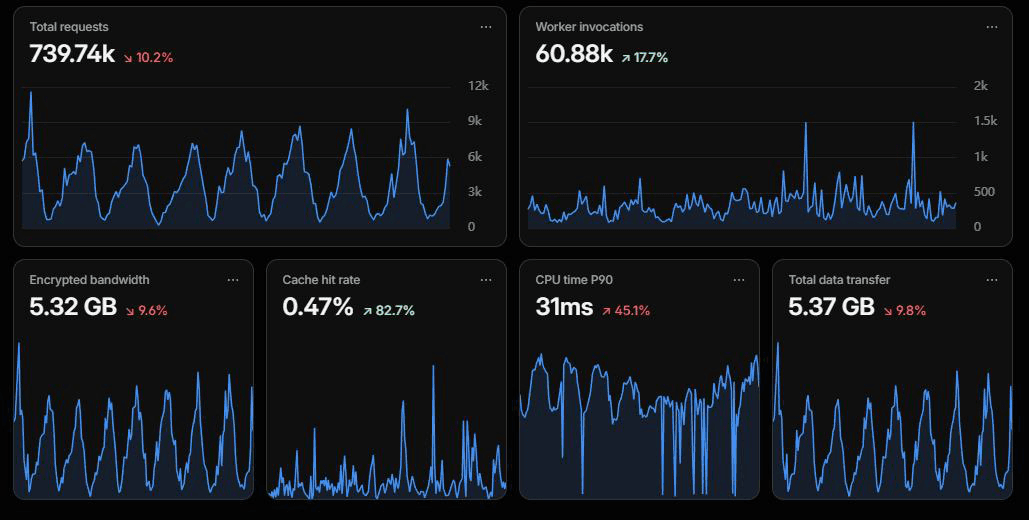
During a measured seven-day period, the infrastructure processed more than 739,000 requests. That included over 60,000 executions of the edge application logic.
P90 Worker CPU time remained at 31 milliseconds throughout the measured period. At the observed traffic level, the system was operating at an equivalent rate of approximately 3.1 million requests per month.
Production traffic7 day measurement
Total requests739K+
Worker invocations60K+
P90 CPU time31 ms
Monthly equivalent3.1M
What we delivered
Keydros established a reusable licensing foundation for independently distributed digital products. Kivo extended it into an automated asset protection workflow without introducing a second authentication system.
- Distributed licence validation
- HMAC-SHA256 request authentication
- Runtime and version verification
- Controlled offline operation
- Automated asset protection
- Edge-based production execution
More work
Continue reading.
Inventory and operations5 min read
From tire sidewall to inventory in seconds
A receiving and storage system for A&C Pneus that reduced tire registration from about a minute to one or two seconds per pair.
Read case studyMeasured result
Up to 98%faster tire registration
Retail systems5 min read
One inventory across every store and sales channel
A connected retail platform that keeps three Brussels stores, Amazon and an online shop working from the same stock record.
Read case studyMeasured result
3 storesconnected to one stock record